Your mind wants to relax, but your body won't let it. You live on high alert even when there's no real danger. Polyvagal Theory offers a clear explanation for why that happens, and, more importantly, what you can do about it.
Quick answer
Polyvagal Theory, developed by neuroscientist Stephen Porges, describes three hierarchical states of the autonomic nervous system: ventral vagal (safety and connection), sympathetic (fight or flight) and dorsal vagal (freeze or shutdown). It explains why your body reacts to threat automatically and how you can train it to return to calm.
For years, anxiety and chronic stress were treated as "all in your head." Polyvagal Theory flipped that idea: much of what we feel doesn't start in our thoughts but in the state of the autonomic nervous system, the body's autopilot.
What is Polyvagal Theory?
Polyvagal Theory is a framework proposed by neuroscientist Stephen Porges in the 1990s. Its central idea is that your nervous system is constantly and unconsciously scanning your surroundings for cues of safety or danger. Porges called this process neuroception: perception that happens below thought, without you deciding anything.
The result of that scan determines which state your body enters, and that state shapes how you feel, digest, sleep and relate to others. Your body decides first; you feel it afterward. That's why "just relax" is so useless when you're fully activated: your rational mind doesn't have access to the switch.
The three states of your nervous system
Porges's key contribution was to describe the autonomic nervous system not as two modes (gas and brake) but as three hierarchical states that switch on depending on how much threat your body perceives:
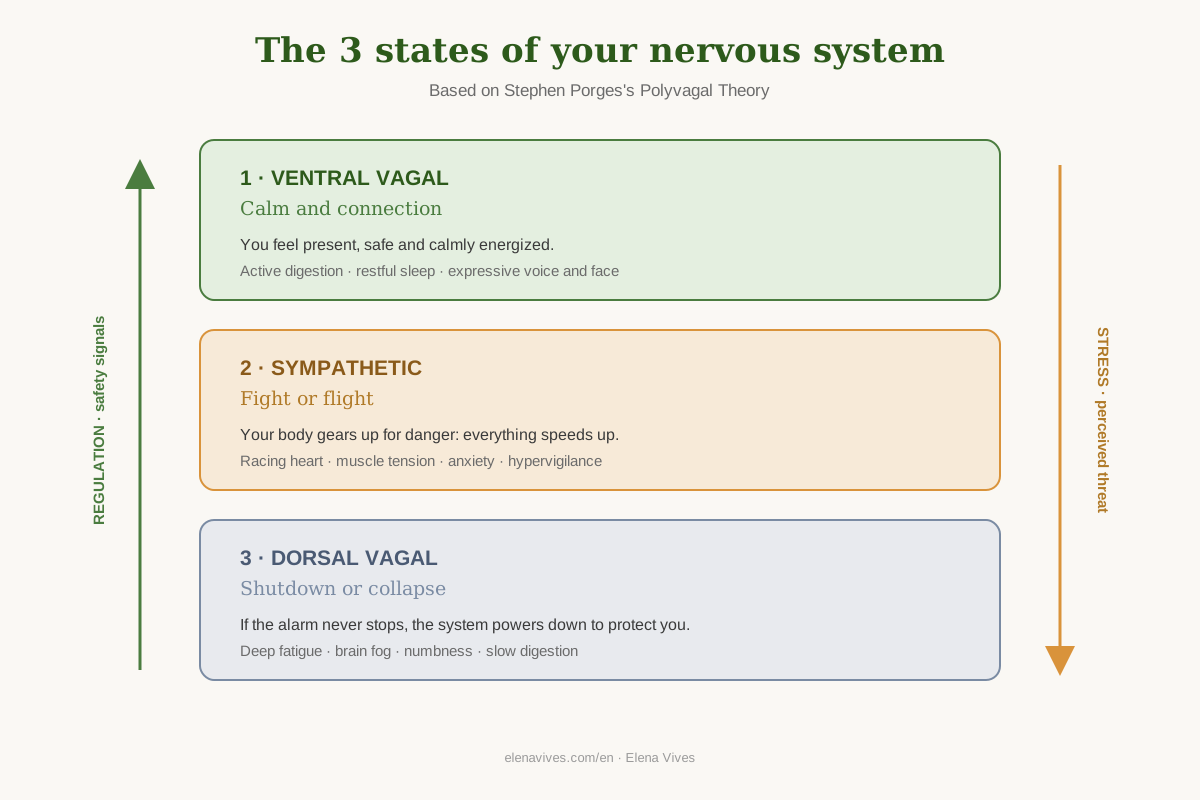
1. Safety and connection (ventral vagal). Your optimal state. The ventral branch of the vagus nerve is active and tells your body all is well. You feel calm, present, social and capable. Your body rests, digests, repairs, balances hormones and sleeps well. It's the state from which you learn, create, connect and make good decisions.
2. Fight or flight (sympathetic). Your body detects a threat and mobilizes. Your heart speeds up, your muscles tense, your breathing gets shallow, cortisol and adrenaline surge. You feel anxious, irritable, hypervigilant, restless. It's a perfect response to short emergencies. The problem is when it stays switched on for days, weeks or months because your body reads a boss's email, a traffic jam and a phone notification as if they were predators.
3. Freeze or shutdown (dorsal vagal). If the threat seems inescapable, when your nervous system "decides" you can neither fight nor flee, your body activates an older mechanism: it powers down. Deep exhaustion, emotional numbness, emptiness, brain fog and apathy follow. It isn't laziness or weakness: it's a survival response that conserves energy in the face of a threat you can't escape.
Neuroception: why your body decides before you do
Neuroception may be the most useful concept in Polyvagal Theory. It's the process by which your nervous system evaluates your environment completely unconsciously, in milliseconds, before you have time to think.
It draws on three sources of information: your external environment (sounds, light, spaces, other people), your internal environment (body sensations, blood sugar, inflammation, pain) and social cues (tone of voice, facial expressions, eye contact).
This explains why you can feel anxious "for no reason": your mind can't find the cause, but your neuroception picked something up (a tone of voice, tension in your body, background noise) that set off the alarm. You're not making it up; your body is responding to information your conscious mind didn't register.
It also explains why certain places calm you (nature, safe people, quiet) and others activate you (noisy offices, crowds, conflict-filled relationships). It isn't just personal preference: it's your neuroception reading safety or danger in real time.
The vagus nerve: the great regulator
The protagonist of Polyvagal Theory is the vagus nerve, which runs from the brainstem down to the abdomen, connecting your brain with your heart, lungs, larynx, stomach and gut.
Porges proposed that the vagus nerve has two branches with very different roles. The dorsal branch, the older one in evolutionary terms, is linked to shutdown and immobilization. The ventral branch, specific to mammals, regulates safety and social connection: when it's active, your heart rhythm is flexible, your voice is expressive, your face is open and your body is in repair mode.
Vagal tone describes how well that calming system works. High vagal tone means flexibility: you can activate for a challenge and come back to calm easily. Low vagal tone means rigidity: you activate and stay there. The good news is that vagal tone is trainable.
How to get back to calm: safety signals
You're not at the mercy of your nervous system. You can send it safety signals on purpose:
- Vagal breathing. In through your nose for 4, out through your mouth for 6. A longer exhale slows your heart rate; five cycles are enough to feel a shift.
- Humming or singing. The vibration in your throat stimulates the vagus nerve. A minute of humming your favorite song counts.
- Safe social contact. A warm conversation, a hug, shared laughter: some of the most powerful safety signals there are.
- Visual orienting. Slowly look around the room and let your eyes rest on things that catch your attention. It tells your neuroception the space is safe.
- Cold water on your face. Triggers the dive reflex and slows your heart within seconds; especially useful in acute anxiety.
- Gradual challenges. Small doses of manageable stress (cool water, gentle exercise, new social situations) followed by recovery train your nervous system's flexibility.
A note on the science
Polyvagal Theory has been hugely influential in trauma therapy and somatic practice, and its practical message (safety signals calm the body) fits well with research on breathing, heart rate variability and social connection. Some of its specific claims about how the vagus nerve evolved are debated among neuroscientists. You don't need to settle that debate to benefit: the tools in this article are useful regardless of how the theory's details are finally resolved.
The good news: your nervous system can be retrained
Your nervous system isn't a life sentence; it's adaptable. Thanks to neuroplasticity, every safety signal strengthens the pathway back to calm. At first it's hard, because your body is used to alert mode and the path to calm is overgrown from lack of use. With practice, it gets faster and more automatic.
Think of it as a trail in the woods. If you've walked the stress trail for years, it's wide and clear. The calm trail is overgrown. Every time you practice a safety signal, you clear a little more of it, until it becomes a road.
That's why the key isn't a miracle technique but gentle repetition: small moments of regulation, several times a day, until your body learns it's safe. That's the step-by-step path of Unlock Your Nervous System.
Free guide: 5 exercises to calm anxiety in 5 minutes. Science-based somatic techniques you can use today.
Get it free →
Unlock Your Nervous System
Somatic exercises to heal trauma, release anxiety, and activate your vagus nerve in 28 days.
Frequently asked questions
What is Polyvagal Theory?
Polyvagal Theory, developed by neuroscientist Stephen Porges, describes three hierarchical states of the autonomic nervous system: ventral vagal (safety and connection), sympathetic (fight or flight) and dorsal vagal (freeze or shutdown). It explains why the body reacts to threat automatically and how we can help it return to calm.
What are the three states of the nervous system?
1) Ventral vagal: safety, social connection, the ability to learn and relate. 2) Sympathetic: alert, fight or flight, anxiety, hyperarousal. 3) Dorsal vagal: shutdown, dissociation, exhaustion, numbness. The nervous system moves between them automatically depending on how it perceives threat.
What is neuroception?
Neuroception is the unconscious process by which the nervous system evaluates whether the environment is safe or dangerous. It happens below awareness: the body decides whether there's danger before the mind analyzes it. That's why somatic anxiety doesn't respond well to rational arguments.
Is Polyvagal Theory scientifically proven?
It's widely used in trauma therapy and its practical tools are supported by research on breathing, heart rate variability and social connection. Some of its specific evolutionary and anatomical claims are still debated by neuroscientists.
This article is educational and does not replace advice from a health professional. If you have intense anxiety or persistent symptoms, talk to a doctor or mental health professional. If you're in crisis in the US, call or text 988.
Sources and references
- Porges, S.W. (2001). The polyvagal theory: phylogenetic substrates of a social nervous system. International Journal of Psychophysiology, 42(2), 123-146. PMID 11812341
- Porges, S.W. (2011). The Polyvagal Theory: Neurophysiological Foundations of Emotions, Attachment, Communication, and Self-Regulation. W. W. Norton.
- Dana, D. (2018). The Polyvagal Theory in Therapy: Engaging the Rhythm of Regulation. W. W. Norton.
- Porges, S.W. (2004). Neuroception: a subconscious system for detecting threats and safety. Zero to Three, 24(5), 19-24.
- Grossman, P. (2023). Fundamental challenges and likely refutations of the five basic premises of the polyvagal theory. Biological Psychology, 180, 108589.