Your vagus nerve is your body's main pathway back to calm. When it's working well, your heart rate is flexible, your digestion runs, and your mind feels clearer. The good news: you can train it much like a muscle. Here are the most effective exercises, explained step by step.
Quick answer
The vagus nerve is the longest cranial nerve in your body. It connects your brain with your heart, lungs, throat and gut, and it's the main nerve of the parasympathetic ("rest and digest") system. Slow breathing with a long exhale, humming, cold water on your face and slow visual orienting are simple ways to stimulate it.
Why train your vagus nerve
The vagus nerve links your brain with your heart, lungs, larynx, stomach and gut. Its ventral branch is tied to the state of safety and connection described in Polyvagal Theory. When your vagal tone is high, your nervous system is flexible: it can gear up for a challenge and come back to calm easily. When it's low, you get stuck on alert.
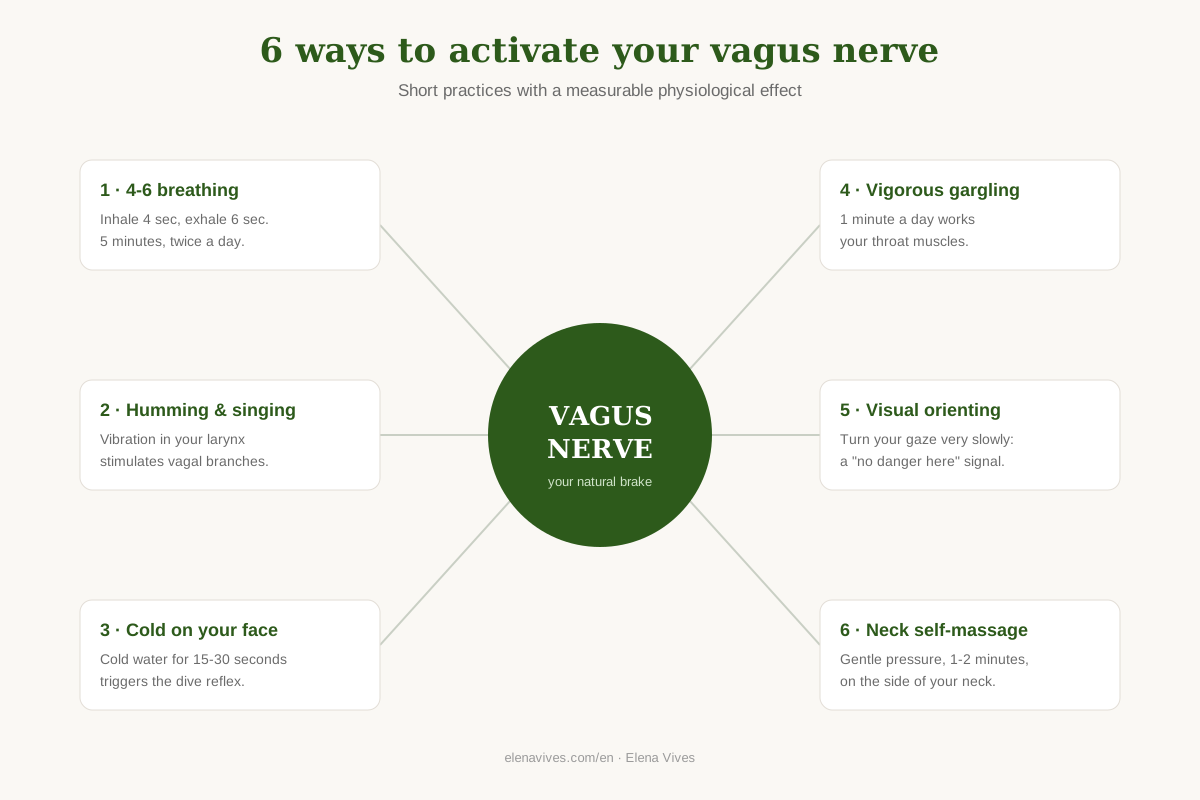
Vagal tone isn't fixed. Every time you stimulate your vagus nerve, you strengthen the neural pathway back to calm. At first it may feel like nothing is happening; after a few weeks, your body starts returning to calm more automatically. That's neuroplasticity in action.
1. Vagal breathing (4-6)
This is the most studied and most accessible exercise. The key is making your exhale longer than your inhale, which engages the vagus nerve and slows your heart rate.
How to do it: Breathe in through your nose for a count of 4. Breathe out through your mouth for a count of 6. Repeat for 5 cycles (about 50 seconds). You can do it sitting, standing or lying down, anywhere.
When to use it: before meals (to switch on digestion), at bedtime, in moments of acute anxiety, or as a morning practice. Three times a day is enough to notice a difference within 2 to 3 weeks.
If 4-6 feels hard at first, start with 3-5 or even 3-4. What matters is that the exhale is longer, not the exact count.
2. Humming and throat vibration
The vagus nerve runs through your larynx. When you hum, chant or sing, the vibration stimulates vagal fibers in your throat. It doesn't matter if you sing well: the effect is mechanical, not musical.
How to do it: Hum a tune you like with your mouth closed for 1 to 2 minutes. Notice the vibration in your throat, chest and face. Singing works too, and adds a long exhale.
Variation: a low, sustained "voo" sound, used in Peter Levine's Somatic Experiencing, resonates deep in the chest and belly, where the main vagal branches travel.
3. Cold water on your face
Cold water on your face triggers the mammalian dive reflex, an ancient response that slows your heart and activates the vagus nerve almost instantly. It's one of the fastest ways to interrupt acute anxiety.
How to do it: Fill the sink with cold water (it doesn't need to be icy), lean over and submerge your face for 15 to 30 seconds. Or splash your face several times, or hold a cold, wet cloth over your forehead and cheeks.
Caution: if you have a heart condition, check with your doctor before using this technique.
4. Slow visual orienting
It looks too simple to work, but it's one of the most powerful ways to switch off hypervigilance. Your nervous system uses visual information to judge whether you're safe. Looking around slowly and deliberately tells it there's no threat.
How to do it: Slowly turn your head to one side, letting your eyes rest on whatever catches your attention: colors, textures, distances. Then turn to the other side. Keep going for 1 to 2 minutes. A spontaneous sigh or yawn is a sign your vagus nerve has kicked in.
5. Shaking and pandiculation
Animals instinctively shake after a stressful experience to discharge tension and complete the stress cycle. Humans have mostly lost that reflex because we suppress it socially. Shaking on purpose brings it back.
How to do it: Stand with your knees slightly bent and start shaking your hands gently. Let the vibration travel up your arms, shoulders and torso, and let your legs join in. There's no "right" way: let your body move for 2 to 3 minutes. Then stand still and notice how you feel.
Pandiculation is the instinctive, yawn-like stretch you do when you wake up. Do it consciously: stretch your arms, open your mouth, yawn (even if it's forced at first). It resets muscle tone and helps your body settle.
6. Vigorous gargling
Gargling works the muscles at the back of your throat, which are supplied by the vagus nerve. The more vigorous, the better: watery eyes are a sign you're engaging the reflex.
How to do it: Every morning when you brush your teeth, take a sip of water and gargle hard for 30 seconds. Repeat 2 or 3 times. It's an easy habit to attach to a routine you already have.
7. Safe social connection
The ventral branch of the vagus nerve is, above all, a social system. It evolved in mammals to regulate connection. That's why contact with people who make you feel safe is one of the strongest safety signals there is: a warm conversation, a hug, shared laughter, even kind eye contact.
If you don't have frequent access to safe social contact, petting a dog or cat can have a similar calming effect. What matters is the quality of the sense of safety, not the number of interactions.
How to fit these into your day
You don't need all seven every day. The most effective approach is to pick 2 or 3 that feel doable and anchor them to specific moments: vagal breathing before each meal, humming while you cook, visual orienting when you get to work, shaking before bed.
The key is consistency, not intensity. Three vagal breaths three times a day, kept up for weeks, change more than a one-hour session once a month. Your nervous system learns through repetition.
Free guide: 5 exercises to calm anxiety in 5 minutes. Science-based somatic techniques you can use today.
Get it free →
Unlock Your Nervous System
Somatic exercises to heal trauma, release anxiety, and activate your vagus nerve in 28 days.
Frequently asked questions
What is the vagus nerve?
The vagus nerve is the longest cranial nerve in the body. It connects the brain with the heart, lungs, larynx, stomach and intestines, and it's the main nerve of the parasympathetic nervous system, which regulates calm, digestion and repair.
How can I stimulate my vagus nerve quickly?
The fastest techniques are vagal breathing (breathing out for longer than you breathe in), cold water on your face (which triggers the dive reflex in 15 to 30 seconds) and humming. For acute anxiety, cold water on your face is usually the most immediate.
How long does it take to see results from vagus nerve exercises?
You can feel calmer after the very first try. Lasting changes in vagal tone, meaning more resilience to stress, usually take 2 to 4 weeks of regular practice. Consistency matters more than duration.
What is vagal tone?
Vagal tone describes how active your vagus nerve is at rest. It's measured indirectly through heart rate variability (HRV): the more the interval between heartbeats varies, the higher your vagal tone. Higher vagal tone is linked to better stress recovery, digestion and emotional health.
This article is educational and does not replace advice from a health professional. If you have intense anxiety or persistent symptoms, talk to a doctor or mental health professional. If you're in crisis in the US, call or text 988.
Sources and references
- Porges, S.W. (2001). The polyvagal theory: phylogenetic substrates of a social nervous system. International Journal of Psychophysiology, 42(2), 123-146. PMID 11812341
- Zaccaro, A. et al. (2018). How breath-control can change your life: a systematic review on psycho-physiological correlates of slow breathing. Frontiers in Human Neuroscience, 12, 353. PMID 30245619
- Lehrer, P.M. & Gevirtz, R. (2014). Heart rate variability biofeedback: how and why does it work? Frontiers in Psychology, 5, 756. PMID 25101026
- Breit, S. et al. (2018). Vagus nerve as modulator of the brain-gut axis in psychiatric and inflammatory disorders. Frontiers in Psychiatry, 9, 44. PMID 29593576