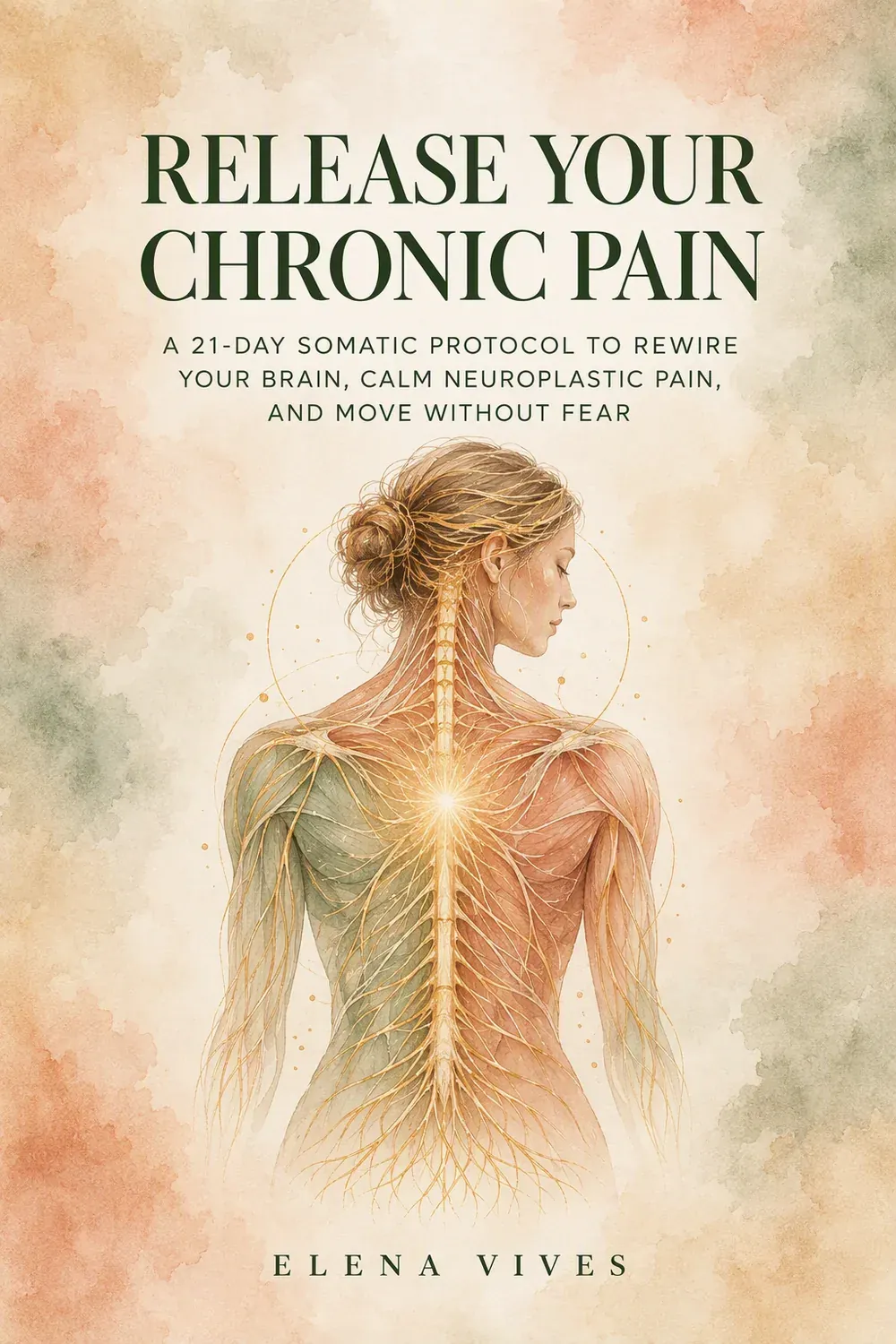
Release Your Chronic Pain
A 21-day somatic protocol to rewire your brain, calm neuroplastic pain, and move without fear.
Elena Vives is the author of this book and earns royalties on each copy sold, at no extra cost to you.
Your MRI says you're "normal." Your doctor says nothing is broken. And yet it hurts: when you sit, when you stand, when you try to sleep. You're not imagining it. Your pain is real. But it may not mean your body is damaged.
Modern pain science has shown that persistent pain is often produced by an overprotective nervous system: a smoke detector stuck on the panic button long after the fire is out. Your brain learned to hurt. The good news? It can learn to feel safe again.
From the author of Unlock Your Nervous System, Reset Your Gut and Rescue Your Hormones, Release Your Chronic Pain translates the latest research on neuroplastic pain into warm, plain language and a step-by-step plan you can follow at home.
No punishing stretches. No "just learn to live with it." Just a nervous system, finally taught that it's safe to stand down.
Does any of this sound familiar?
This book was written for you if…
What you'll learn
- How to recognize the signs of neuroplastic (learned) pain, and why it moves around, flares with stress and ignores your scans
- How to use somatic tracking, the core skill behind pain reprocessing, to turn down the alarm instead of fighting it
- How to sharpen blurry brain maps with pandiculation and slow micro-movements, not punishing stretches
- How to calm neuroinflammation through sleep, food and the safety signals your glial cells are waiting for
- How emotions, stress and past trauma feed the pain alarm, and how to start turning the volume down
- How to break the push-crash cycle with somatic pacing designed for perfectionist minds
- How to use graded motor imagery when movement itself feels threatening
- How to get through flare-ups without panic, and why a setback can be a sign that healing is working
How the book is organized
The neuroplastic pain loop, the prediction error behind persistent pain, and neuroinflammation: how your glial "caretaker" cells keep the alarm switched on.
Somatic armor, your inner GPS and Penfield's homunculus, sensory incongruence, and how to talk to your alarm system so it can stand down.
Emotions, trauma and pain; somatic sleep; nutrition for a calm nervous system; and how your environment feeds your alarm.
The biology of relapse, somatic pacing and graded motor imagery, then your 21-day road map. Week 1, Desensitization. Week 2, Reprogramming and Maps. Week 3, Integration and Biological Pleasure. It closes with the Somatic Pain Atlas, a quick-reference guide to ten common patterns: headaches and migraine, low back, pain down the leg, jaw and TMJ, fibromyalgia, neck and shoulder blades, chest tightness, wrists and hands, knees, and arches and heels.
The science behind the method
Pain is a protective output of the brain. Pain doesn't measure tissue damage directly. Your brain weighs signals from the body together with context, memory and expectation, and decides how much protection you need. That's why two people with the same scan can feel completely different amounts of pain.
Central sensitization. In a landmark 2011 review in the journal Pain, Clifford Woolf described central sensitization: the central nervous system amplifies pain signals, so things that didn't hurt before start to hurt, and things that hurt a little start to hurt a lot. It helps explain why treatments aimed only at the tissues often fall short for long-lasting pain.
Pain reprocessing therapy. In a randomized trial published in JAMA Psychiatry in 2022 (Ashar et al.), 66% of people with chronic back pain who received pain reprocessing therapy were pain-free or nearly pain-free after treatment, compared with 20% in the placebo group and 10% with usual care. Somatic tracking, one of the core skills in this book, comes from that approach.
Sensory-motor amnesia. Somatic educator Thomas Hanna described how, under chronic stress, the nervous system can "forget" how to release certain muscles, keeping them in a protective contraction. Pandiculation and slow micro-movements help restore that voluntary control.
The book turns this science into gentle daily practices built around one principle: a nervous system that feels safe no longer needs to sound the alarm.
Who this book is NOT for
- It's not for acute or structural pain. If you have a recent injury, a fracture, an infection, active inflammation or a serious condition such as cancer, see your medical team first. This book is about pain that lingers after the tissues have had time to heal.
- It doesn't replace medical care. Get any new, severe or changing pain checked by a doctor before assuming it's neuroplastic. The book complements physical therapy and psychological support; it doesn't replace them.
- It doesn't promise a quick fix. Retraining the nervous system is gradual, and results vary with how long and how intensely you've lived with pain. The 21-day protocol is a first cycle, not a finish line.
- It asks you to relate to pain differently. The method includes noticing sensations with curiosity instead of running from them. That can feel uncomfortable at first; the book walks you through it step by step.
What readers of the original edition say
The Spanish edition, Libera tu Dolor Crónico, is rated 4.5 out of 5 stars by its first readers on Amazon Spain. If you read the English edition, a short review on Amazon helps other people living with chronic pain decide whether this book is for them.
Frequently asked questions
How do I know if my pain is neuroplastic?
The book walks you through the common signs: pain that started without a clear injury or outlasted the healing of one, pain that moves around or switches sides, pain that flares with stress, and scans that don't explain how much it hurts. A doctor should rule out structural and medical causes first; the book is not a diagnostic tool.
Is this book helpful for fibromyalgia?
Yes, as a complement to your medical care. Fibromyalgia is closely linked to central sensitization, the mechanism the REMAP Protocol works with, and the Somatic Pain Atlas includes a specific section on widespread pain patterns. The protocol starts very gently and progresses gradually.
Is it backed by science?
The book draws on modern pain neuroscience: central sensitization (Woolf), pain education (Moseley), pain reprocessing therapy, including the 2022 randomized trial by Ashar and colleagues in JAMA Psychiatry, and Thomas Hanna's work on sensory-motor amnesia. An appendix lists the key studies and resources so you can read them yourself.
What if I have a flare-up during the protocol?
Flare-ups are expected while your nervous system learns a new route, and they don't mean the protocol has failed. The book gives you a plan for them: calm the alarm with vagal regulation, use somatic tracking to lower the fear response, and adjust your pacing instead of quitting.
How long until I notice a difference?
It varies a lot from person to person, depending on how long and how intensely you've had pain. The REMAP Protocol is a 21-day first cycle; many readers repeat it and keep the tools as part of their routine.
Is this a translation?
Yes. It's the English edition of Libera tu Dolor Crónico, originally published in Spanish and adapted for US readers (US units, health care terms and resources). It's the fourth book in the Somatic Healing Series, after Unlock Your Nervous System, Reset Your Gut and Rescue Your Hormones.
Start your 21-day REMAP Protocol
Your pain is real. And a brain that learned to hurt can learn to feel safe again.
Get Release Your Chronic Pain →
Unlock Your Nervous System
28 days of somatic exercises to calm anxiety and activate your vagus nerve: the safety signal your pain alarm is waiting for.
Keep reading: the complete nervous system guide · vagus nerve exercises · Polyvagal Theory, explained
¿Prefieres leerlo en español? Libera tu Dolor Crónico