Bloating, gas, IBS, food sensitivities that seem to come out of nowhere, reflux, constipation that alternates with diarrhea. You've tried diets, probiotics, elimination plans and food sensitivity tests, and nothing quite works. What if the problem isn't what you eat, but the state of your nervous system while you eat?
Quick answer
Digestion only works well when your nervous system is in a calm, "rest and digest" state. If you eat in stress mode, your gut slows down: food ferments, bacteria can build up (SIBO) and bloating follows. Restrictive diets don't fix that root cause. Calming your vagus nerve before you eat is the real first step.
Digestion is a luxury process
Your body runs on a limited energy budget. When it senses a threat, real or perceived, it sends resources to the systems that keep you alive right now: heart, muscles, brain. And it cuts whatever isn't urgent for the next five minutes.
Digestion is the first thing to go. Digesting takes a big increase in blood flow to the gut, well-timed release of stomach acid and enzymes, coordinated muscle movement and a balanced microbiome. All of that runs best when your nervous system is in safety mode, with the parasympathetic branch in charge.
If you eat in fight-or-flight mode (after rushing to work, during an argument, in front of a screen that keeps you on edge), your gut receives food but doesn't get the biological green light to process it. Food sits, ferments and produces gas. The result is the bloating, discomfort and pressure you know so well.
Free guide: 5 exercises to calm anxiety in 5 minutes. Quick vagus nerve techniques you can also use right before you eat.
Get it free →The gut-brain axis: a two-way highway
Your gut and your brain aren't two separate organs that occasionally exchange messages. They're linked by a two-way communication network called the gut-brain axis, and the vagus nerve is one of its main cables.
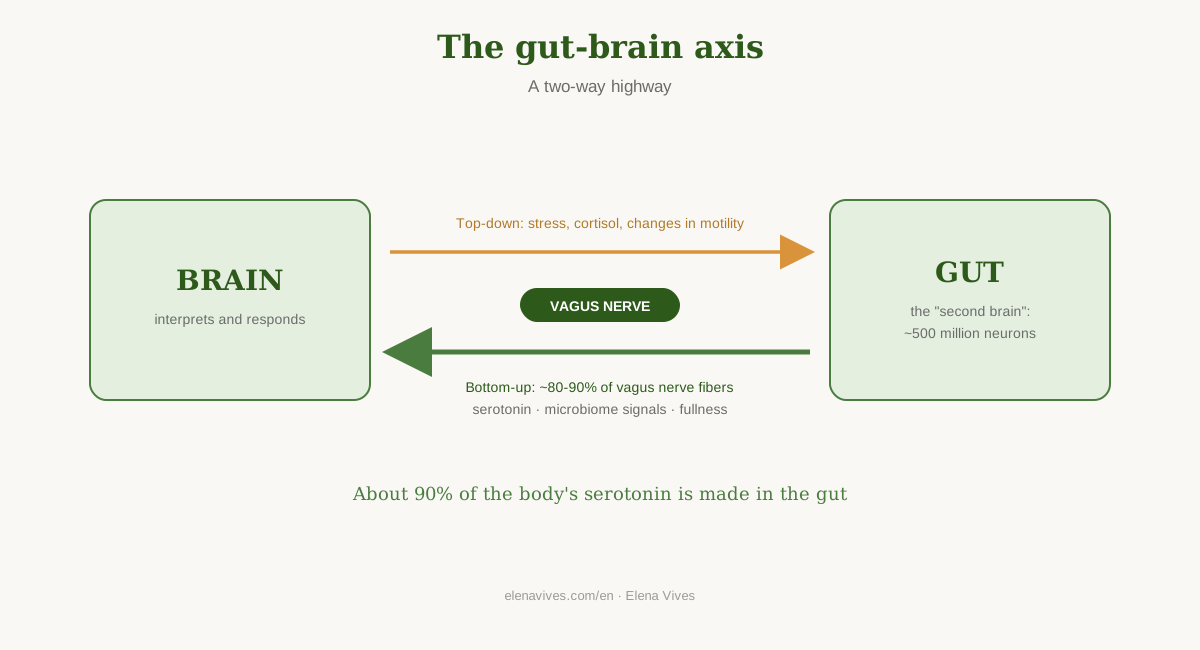
The connection runs both ways. Your brain affects your gut: when you're stressed, digestion slows, the gut lining becomes more permeable and the microbiome shifts. And your gut affects your brain: roughly 80-90% of vagal fibers carry signals up from the gut. Your gut is constantly reporting on your inner environment, and that information shapes your mood, focus and anxiety levels.
That's why "second brain" isn't just a metaphor. Your gut has its own nervous system, the enteric nervous system, with hundreds of millions of neurons. It can run digestion largely on its own while staying in constant conversation with your brain. Read more in the gut-brain axis explained.
The vagus nerve: the conductor of your digestion
The vagus nerve is involved in almost every step of digestion. It stimulates stomach acid (needed to break down protein and absorb minerals), triggers pancreatic enzymes and bile flow, coordinates the muscle movements that push food along, and helps regulate the junction between your small and large intestine.
When vagal tone is low, because your nervous system has been stuck on alert, the whole orchestra goes out of tune. Your stomach makes less acid, enzymes arrive late or in short supply, motility slows and food lingers where it shouldn't.
This explains something many women notice and doctors rarely connect: why gut problems appear or get worse during stressful periods, why the same meal agrees with you one day and not the next, and why vacations seem to "cure" your stomach for a while.
SIBO: the overgrowth nobody explains well
SIBO (small intestinal bacterial overgrowth) is one of the most common causes of chronic bloating, and it has a direct link to the nervous system that rarely gets mentioned.
Your gut has a self-cleaning system called the Migrating Motor Complex (MMC): waves of contraction that sweep leftover food and bacteria from the small intestine toward the colon between meals. It only runs when you're not eating, and it works best when your body is calm. If you snack all day or your nervous system is constantly activated, the MMC struggles to do its job.
Without that cleaning, bacteria can build up in the small intestine and ferment food before it's absorbed. The result: gas, pressure, distension after meals, belching and changes in bowel habits that don't respond to standard treatment, because nobody is addressing the root. Read the full picture in SIBO: symptoms, causes and the vagus nerve connection.
Your microbiome: the ecosystem inside you
Trillions of microorganisms live in your gut and make up your gut microbiome. It isn't a passive passenger: it helps break down fiber, produces some vitamins, trains your immune system and makes compounds that influence your nervous system.
Chronic stress changes the microbiome directly. Stress hormones are linked to fewer beneficial bacteria (like Lactobacillus and Bifidobacterium) and more inflammatory species. That imbalance, called dysbiosis, can weaken the gut barrier and fuel low-grade inflammation that affects the whole body.
It works the other way too: a struggling microbiome sends alarm signals to the brain through the vagus nerve, which raises anxiety and alertness. Stress, dysbiosis, more alarm signals, more stress: a vicious circle you can break from either end.
The gut that shapes your mood
About 90% of your body's serotonin is made in the gut, mainly by specialized cells in the gut lining whose activity is influenced by your microbiome. Gut serotonin doesn't cross into the brain, but it helps control gut movement and sends signals through the vagus nerve that influence mood, sleep and appetite.
That's one reason digestive problems and low mood so often show up together. They aren't two separate problems; they're two sides of the same imbalance. Caring for your digestion is part of caring for your mental health.
Why restrictive diets don't work on their own
Gluten, dairy, FODMAPs, histamine... Many women end up eating a handful of foods and are still bloated. Restriction can bring temporary relief because there's less to ferment, but it doesn't fix the cause. And it has a cost: the fewer foods you eat, the less diverse your microbiome becomes, and a less diverse gut tends to be more reactive.
Food matters, but it's the second piece of the puzzle, not the first. The first is getting your nervous system back into a state where your gut has permission to work. From there, foods that used to bother you often become easier to tolerate.
Somatic tools for your digestion
If the root of the problem is a nervous system stuck on alert, the solution is to send safety signals before, during and after you eat:
Breathe before you eat
Three slow breaths (in for 4, out for 6) right before your first bite. A longer exhale activates the parasympathetic branch and tells your body it's safe to digest. It's the switch that turns your digestive machinery on.
Abdominal massage
A gentle clockwise self-massage of your belly encourages movement, helps release trapped gas and stimulates nerve endings in your gut. Five minutes before bed can change how you feel in the morning.
Eat without screens
Screens keep your sympathetic system switched on. Sitting down, eating without screens and chewing slowly isn't a mindfulness luxury: it's the minimum your nervous system needs to turn digestion fully on.
The drain button
A gentle massage over your ileocecal valve, the junction between your small and large intestine in the lower right of your belly. It's one of the signature tools in Reset Your Gut for preventing backflow and easing bloating.

Reset Your Gut
21 days of somatic tools, warm and gentle recipes and a plan to reset your gut-brain axis.
Leaky gut: what it really is
"Leaky gut" has become a catch-all term in wellness circles. It's worth understanding what it means physiologically, because the underlying idea, increased intestinal permeability, is real, even if it's often oversold.
Your gut is lined with a single layer of cells held together by tight junctions. They act as a filter: they let nutrients through and keep bacteria, toxins and partly digested food particles out of your bloodstream.
Chronic stress, high cortisol and dysbiosis can loosen those junctions. When more passes through than should, the immune system reacts, and the resulting low-grade inflammation can show up far from the gut: achy joints, brain fog, skin flare-ups.
There's no single test for "leaky gut" accepted by mainstream medicine, and supplements like glutamine or collagen are not a fix on their own. What helps most consistently is lowering the stress load on your system so your gut lining can repair.
The histamine trap
Histamine intolerance is common in women with chronic gut problems, and widely misunderstood. Histamine is a molecule your body makes naturally (for immune responses, stomach acid and as a neurotransmitter) and that's also found in aged, cured and fermented foods. Your gut breaks it down with an enzyme called DAO.
Many foods people cut on "anti-inflammatory" diets (wine, aged cheese, tomatoes, spinach, cured meats) are high in histamine. Cutting them can help for a while, but if the gut stays inflamed and DAO activity stays low, the problem persists. Calming your system so your gut can heal is the step that changes the picture.
Signs your microbiome is struggling
None of these signs is a diagnosis on its own, but when several show up together, it's worth looking at your gut and your nervous system as one system.
A full-day somatic gut routine
You don't need to set aside hours. These steps fit into a normal day:
Morning: wake up your digestion
Two minutes of gentle movement (waist twists, walking around the house) and a glass of warm water get things moving. Three slow breaths with a long exhale before your first bite.
At meals: the minimum conditions
Sit down. No screens. Chew each bite well; digestion starts in your mouth, and food that arrives half-chewed is more likely to ferment. Eat slowly, with pauses.
After meals: no intense exercise, no lying down
A gentle 10 to 15-minute walk is ideal: it supports motility, helps balance blood sugar and calms your system through rhythmic movement.
At night: let the cleaning crew work
Finish dinner at least two hours before bed so your Migrating Motor Complex can start its first cleaning cycle. Snacking after dinner resets the clock. A gentle clockwise belly massage before sleep helps release gas.
The 12-hour rule
An overnight gap of about 12 hours between dinner and breakfast gives your MMC time for several cleaning cycles. Dinner at 8 p.m., breakfast at 8 a.m. It's basic gut hygiene many diets overlook.
Frequently asked questions
Why do I bloat even when I eat healthy?
Bloating doesn't depend only on what you eat but on the state of your nervous system while you eat. If your body is in stress mode, digestion slows down even when the food is healthy. Your vagus nerve needs to be active for your gut to work properly.
What does stress have to do with SIBO?
Chronic stress slows the Migrating Motor Complex, the self-cleaning wave that sweeps the small intestine between meals. Without it, bacteria can build up in the small intestine. Calming the nervous system helps that cleaning wave work again.
Do restrictive diets cure bloating?
They can bring short-term relief by reducing fermentation, but they don't fix the cause. Over-restricting also narrows your microbiome, which over time can mean more sensitivity and more bloating. The first step is regulating your nervous system.
Keep reading
The gut-brain axis: why your belly shapes your mood
Read →SIBO: symptoms, causes and the vagus nerve connection
Read →Why you bloat in the afternoon (and it's not what you eat)
Read →This content is educational and does not replace advice from a health professional. If you have persistent digestive symptoms, see your doctor or a GI specialist, and seek care promptly for blood in your stool, unexplained weight loss, fever or severe pain.
Scientific references
- Carabotti, M. et al. (2015). The gut-brain axis: interactions between enteric microbiota, central and enteric nervous systems. Annals of Gastroenterology, 28(2), 203-209. PMID 25830558
- Bonaz, B. et al. (2018). The vagus nerve at the interface of the microbiota-gut-brain axis. Frontiers in Neuroscience, 12, 49. doi:10.3389/fnins.2018.00049
- Mayer, E.A. (2011). Gut feelings: the emerging biology of gut-brain communication. Nature Reviews Neuroscience, 12(8), 453-466. doi:10.1038/nrn3071
- Pimentel, M. et al. (2020). ACG Clinical Guideline: Small Intestinal Bacterial Overgrowth. American Journal of Gastroenterology, 115(2), 165-178. PMID 32023228
- Cryan, J.F. et al. (2019). The microbiota-gut-brain axis. Physiological Reviews, 99(4), 1877-2013. PMID 31460832
- Konturek, P.C. et al. (2011). Stress and the gut: pathophysiology, clinical consequences, diagnostic approach and treatment options. Journal of Physiology and Pharmacology, 62(6), 591-599. PMID 22314561