Ever felt butterflies before an exam, or lost your appetite after bad news? That's no coincidence: your gut and your brain are in constant conversation through what scientists call the gut-brain axis.
Quick answer
The gut-brain axis is the two-way communication system between your gut and your brain. It includes the vagus nerve, the enteric nervous system (your gut's 'second brain'), gut hormones, signals from the microbiome and immune pathways. Most of the traffic on the vagus nerve runs from the gut up to the brain, not the other way around.
The gut-brain connection isn't a metaphor or a wellness trend: it's a real biological highway. Understanding it changes the way you care for both your digestion and your mood.
What is the gut-brain axis?
The gut-brain axis is the network that connects your digestive system with your central nervous system in both directions. Your brain influences how you digest, and what happens in your gut sends signals that affect your mood, energy and mental clarity.
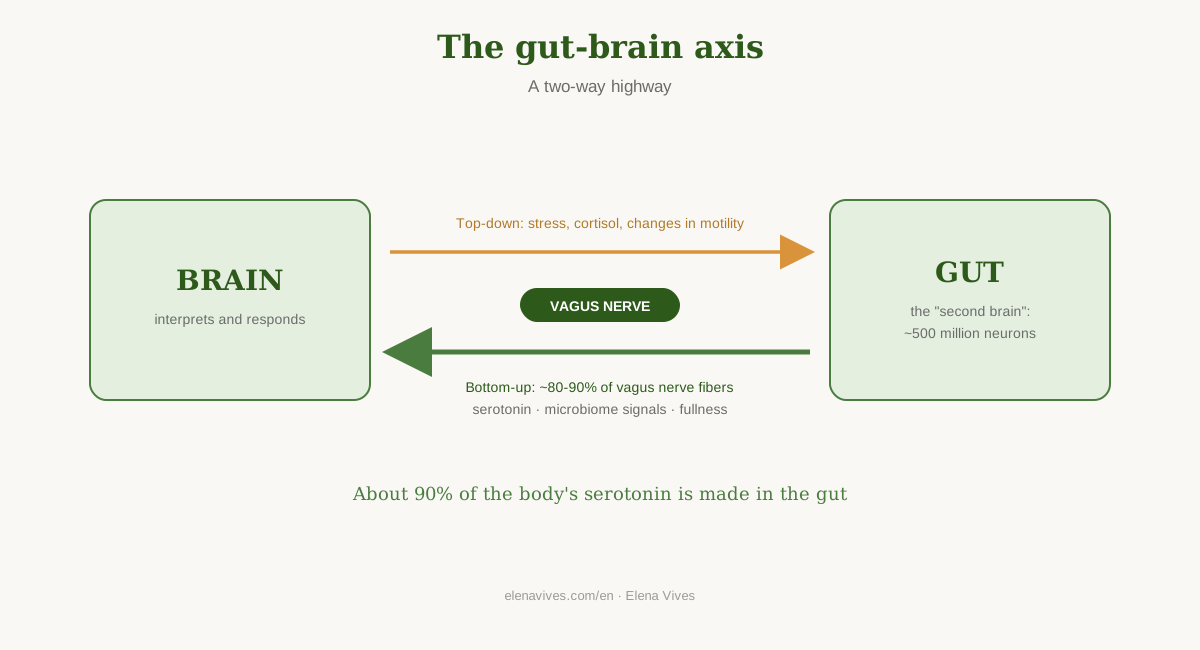
The conversation happens through three main channels: the vagus nerve (the direct nerve line), the immune system (inflammatory molecules that travel in the blood) and the endocrine system (hormones and signaling molecules made in the gut). All three run at once, which is why a gut problem can affect your mood, sleep and focus at the same time.
Your "second brain": more neurons than you'd think
Your gut is lined with a dense network of nerve cells called the enteric nervous system, with hundreds of millions of neurons (estimates often land around 500 million), more than in your spinal cord. Because it can run digestion largely on its own, scientists nicknamed it the "second brain."
The enteric nervous system controls the muscle movements that push food along, the release of digestive juices, blood flow to the gut and the barrier that decides what gets into your bloodstream. When it works well, you don't notice a thing. When it's dysregulated, you get the symptoms you know too well: bloating, pain, gas, constipation or diarrhea.
Serotonin: the feel-good molecule your gut makes
Here's the fact that surprises almost everyone: about 90% of your body's serotonin is made in the gut, mostly by specialized cells in the gut lining. Gut serotonin doesn't cross into the brain, but it helps regulate gut movement and sends signals through the vagus nerve that influence mood, sleep and appetite.
Your microbiome influences how much serotonin those cells make. When there's inflammation, dysbiosis (an imbalanced microbiome) or low vagal tone, that system works less well, and because gut serotonin also drives motility, constipation or irregular bowel habits can follow.
This helps explain something mainstream medicine has been slow to recognize: many people with IBS, chronic bloating or SIBO also live with anxiety, low mood or brain fog. They aren't two separate problems; they're two sides of the same imbalance.
The microbiome: the ecosystem that shapes your health
The trillions of bacteria, viruses and fungi in your gut make up your gut microbiome. It helps break down fiber, makes some B vitamins and vitamin K, trains your immune system (a large share of which lives in and around the gut) and produces compounds such as short-chain fatty acids and GABA that affect your nervous system.
Chronic stress changes the microbiome directly. Stress is linked to fewer beneficial bacteria (like Lactobacillus and Bifidobacterium) and more inflammatory species. This dysbiosis can weaken the gut barrier and drive low-grade inflammation that reaches the brain, joints, skin and metabolism.
And the circle closes: a struggling microbiome sends alarm signals to the brain through the vagus nerve, which raises sympathetic activation and cortisol. More stress, worse microbiome, more alarm signals, more stress. Breaking the cycle means working on both ends: calming your nervous system and feeding your gut ecosystem.
The vagus nerve: the cable that connects them
The main channel of this conversation is the vagus nerve. The surprising part is that roughly 80-90% of its fibers are afferent: they carry information up from the gut. Your gut talks to your brain far more than your brain talks to your gut.
When vagal tone is high, digestion works, the gut barrier holds, inflammation stays in check and signaling is balanced. When vagal tone is low, which is extremely common with chronic stress, the whole chain suffers.
That's why calming your nervous system with somatic practices (vagal breathing, humming, visual orienting) can improve digestion even without changing your diet. And it's why caring for your gut with fiber, fermented foods and variety can help calm anxiety. You can work on the axis from either end.
How to care for your gut-brain axis
- Before you eat: three slow breaths (in for 4, out for 6) to tell your body it's safe to digest.
- While you eat: sit down, no screens, chew slowly. Chewing is the first step of digestion and triggers reflexes that prepare your stomach and pancreas.
- What you eat: varied fiber (vegetables, fruit, legumes) and fermented foods (yogurt, kefir, sauerkraut). Variety matters more than quantity: the more kinds of plant fiber you eat, the more diverse your microbiome.
- Between meals: leave real gaps so your gut's self-cleaning wave, the Migrating Motor Complex, can do its job. Constant snacking blocks it.
- At night: protect your sleep. Your gut has its own daily rhythm, and poor sleep changes the makeup of your microbiome.
Signs your gut-brain axis is out of balance
They rarely show up alone. Caring for your gut and your nervous system together, instead of separately, is what makes the real difference.
Free guide: 5 exercises to calm anxiety in 5 minutes. Science-based somatic techniques you can use today.
Get it free →
Reset Your Gut
Somatic healing to beat bloating, relieve SIBO, and calm your gut-brain axis in 21 days.
Frequently asked questions
What is the gut-brain axis?
The gut-brain axis is the two-way communication system between the gut and the brain. It includes the vagus nerve, the enteric nervous system (the gut's 'second brain'), gut hormones, signals from the microbiome and immune pathways. Most vagus nerve fibers carry information from the gut to the brain.
Why does the gut make serotonin?
About 90% of the body's serotonin is made by enterochromaffin cells in the gut lining, where it helps control gut movement and signaling. It doesn't cross into the brain, but it sends signals through the vagus nerve that influence mood, sleep and appetite.
How does stress affect the gut?
Chronic stress activates the sympathetic nervous system, which slows digestion (less stomach acid and enzymes, slower motility), can increase gut permeability, changes the microbiome and lowers the vagal tone that coordinates digestion. A stressed gut, in turn, sends more alarm signals to the brain.
How can I improve my gut-brain connection?
Work on both ends: calm your nervous system before meals with slow breathing, eat sitting down and without screens, leave gaps between meals, protect your sleep, and eat a wide variety of plant fiber and fermented foods.
This article is educational and does not replace advice from a health professional. If you have intense anxiety or persistent symptoms, talk to a doctor or mental health professional. If you're in crisis in the US, call or text 988.
Sources and references
- Mayer, E.A. et al. (2014). Gut microbes and the brain: paradigm shift in neuroscience. Journal of Neuroscience, 34(46), 15490-15496. PMID 25392516
- Cryan, J.F. & Dinan, T.G. (2012). Mind-altering microorganisms: the impact of the gut microbiota on brain and behaviour. Nature Reviews Neuroscience, 13(10), 701-712. PMID 22968153
- Bonaz, B., Bazin, T. & Pellissier, S. (2018). The vagus nerve at the interface of the microbiota-gut-brain axis. Frontiers in Neuroscience, 12, 49. PMID 29467611
- Carabotti, M. et al. (2015). The gut-brain axis: interactions between enteric microbiota, central and enteric nervous systems. Annals of Gastroenterology, 28(2), 203-209. PMID 25830558