You bloat after eating even when you eat well. The gas never stops. Nothing seems to agree with you. You've tried elimination diets, probiotics and digestive enzymes, and the problem is still there. If that sounds familiar, the issue may not be what you eat, but where the bacteria that digest it are living.
Quick answer
SIBO stands for small intestinal bacterial overgrowth: bacteria that normally live mainly in the colon build up in the small intestine, ferment food too early and produce gas that causes bloating, pain and changes in bowel habits. It's diagnosed with a breath test, usually treated with antibiotics, and tends to return unless gut motility is restored.
What is SIBO?
SIBO stands for small intestinal bacterial overgrowth. Normally, your small intestine contains relatively few bacteria; most of your gut bacteria live in the colon. When bacteria build up in the small intestine, they ferment food long before it reaches the colon and produce abnormal amounts of gas (hydrogen, methane or hydrogen sulfide). That gas drives the classic SIBO symptoms.
SIBO is more common than it's diagnosed. Research over the last two decades has linked it to a meaningful share of IBS cases and to persistent digestive problems without an obvious cause.
SIBO symptoms
Symptoms vary depending on which gas dominates, but the most common are:
A very typical pattern is bloating that builds through the day: you wake up with a flat stomach and by mid-afternoon you look months pregnant, as gas accumulates with every meal.
Methane-dominant overgrowth (now often called IMO, intestinal methanogen overgrowth) tends to go with constipation and hard distension. Hydrogen-dominant SIBO is more often linked to diarrhea and gas soon after eating. Hydrogen sulfide SIBO is the least studied and is associated with sulfur-smelling gas.
What causes SIBO?
Your small intestine stays relatively clear of bacteria thanks to several defenses. The most important is the Migrating Motor Complex (MMC), waves of contraction between meals that act like a broom, sweeping contents (bacteria included) toward the colon. When it falters, bacteria accumulate.
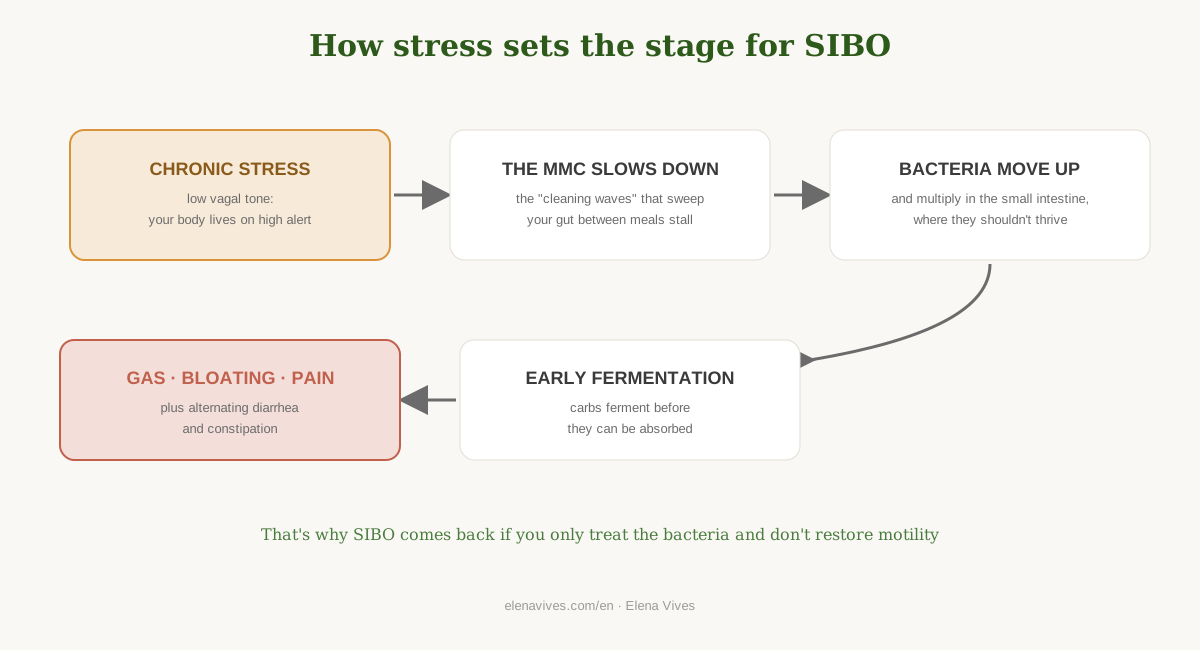
- Slow motility: the most common cause. It can come from hypothyroidism, diabetes with nerve damage, previous abdominal surgery or, very often, the effect of chronic stress on gut function.
- Low stomach acid: stomach acid is your first antibacterial barrier. With low acid (from long-term acid-reducing medication, age or chronic stress), more bacteria survive and reach the small intestine.
- Ileocecal valve dysfunction: this valve separates the small intestine from the colon. If it doesn't close well, colon bacteria can flow backward.
- Antibiotics and microbiome disruption: a course of antibiotics can wipe out protective bacteria and leave room for overgrowth.
- Diet high in sugars and fermentable carbs: FODMAPs are the favorite fuel of SIBO bacteria. They don't cause SIBO on their own, but they feed it once it's established.
SIBO and the vagus nerve: the link you can't ignore
This is the piece most people never hear about, and it's key to understanding why SIBO comes back again and again despite treatment.
The vagus nerve is the main nerve of the parasympathetic system and helps coordinate movement along the whole digestive tract, including the Migrating Motor Complex. When chronic stress keeps your body in fight-or-flight, gut motility slows down.
- A slower or less frequent MMC means bacteria aren't swept toward the colon and can build up in the small intestine.
- Less stomach acid means more bacteria survive the stomach.
- Fewer digestive enzymes and less bile mean food is digested less completely, leaving more for bacteria to ferment.
That helps explain why SIBO is so common in people with chronic anxiety, chronic fatigue or a history of trauma: a nervous system in survival mode keeps turning digestion down. Treating SIBO without working on your nervous system is like mopping the floor while the faucet is still running.
How SIBO is diagnosed
The standard test is a breath test with lactulose or glucose. You drink a sugar solution on an empty stomach, and hydrogen and methane in your breath are measured over 2 to 3 hours. An early rise suggests overgrowth in the small intestine. Glucose tests are more specific but mostly detect overgrowth in the upper small intestine; lactulose covers more of it but gives more false positives.
Culturing fluid from the small intestine is the technical gold standard, but it requires an endoscopy and is rarely used in everyday practice.
SIBO and IBS overlap but aren't the same thing: IBS is a diagnosis based on symptoms; SIBO has an identifiable mechanism and a specific test. Some cases labeled as IBS turn out to be undiagnosed SIBO.
Treatment: beyond antibiotics
Conventional treatment usually involves antibiotics, most often rifaximin, which acts locally in the gut. For methane-dominant cases, doctors often combine it with a second antibiotic such as neomycin. Success rates are good, but so are relapse rates when the underlying causes aren't addressed: in one study, about 44% of patients relapsed within nine months.
A complete approach adds restoring gut motility (sometimes with prokinetic medication), correcting low stomach acid if present, dietary support during treatment (such as a low-FODMAP approach, or an elemental diet in severe cases) and addressing chronic stress as a maintaining factor.
On the nervous system side, vagus nerve exercises (vagal breathing, humming, visual orienting) and slow belly breathing before meals are simple tools that support motility. They don't replace medical treatment, but they support it and can help reduce relapses.
Free guide: 5 exercises to calm anxiety in 5 minutes. Science-based somatic techniques you can use today.
Get it free →
Reset Your Gut
Somatic healing to beat bloating, relieve SIBO, and calm your gut-brain axis in 21 days.
Frequently asked questions
What exactly is SIBO?
SIBO stands for small intestinal bacterial overgrowth. Bacteria that normally live mostly in the colon build up in the small intestine, ferment food too early and produce gas that causes bloating, pain and changes in bowel habits.
What are the most common SIBO symptoms?
Bloating that worsens through the day, excess gas, abdominal pain or cramps, alternating constipation and diarrhea, belching, fatigue and brain fog. In more advanced cases, low vitamin B12, iron and fat-soluble vitamins can appear.
How is SIBO diagnosed?
Usually with a lactulose or glucose breath test that measures hydrogen and methane over 2 to 3 hours. An early rise suggests SIBO. Culturing fluid from the small intestine is more precise but invasive and rarely used.
What does stress have to do with SIBO?
Chronic stress slows gut motility, including the Migrating Motor Complex, the cleaning wave that sweeps the small intestine between meals. Without it, bacteria can build up. Calming the nervous system is an important part of long-term recovery.
Does SIBO go away on its own?
Rarely. Treatment usually includes antibiotics prescribed by a doctor. Without addressing the underlying causes (motility, stress, stomach acid), relapses are common. The most effective approach combines medical treatment with restoring motility and calming the nervous system.
This article is educational and does not replace advice from a health professional. If you have intense anxiety or persistent symptoms, talk to a doctor or mental health professional. If you're in crisis in the US, call or text 988.
Sources and references
- Pimentel, M. et al. (2020). ACG Clinical Guideline: Small Intestinal Bacterial Overgrowth. American Journal of Gastroenterology, 115(2), 165-178. PMID 32023228
- Rezaie, A. et al. (2017). Hydrogen and methane-based breath testing in gastrointestinal disorders: the North American Consensus. American Journal of Gastroenterology, 112(5), 775-784. PMID 28323273
- Sachdev, A.H. & Pimentel, M. (2013). Gastrointestinal bacterial overgrowth: pathogenesis and clinical significance. Therapeutic Advances in Chronic Disease, 4(5), 223-231. PMID 23997926
- Lauritano, E.C. et al. (2008). Small intestinal bacterial overgrowth recurrence after antibiotic therapy. American Journal of Gastroenterology, 103(8), 2031-2035.